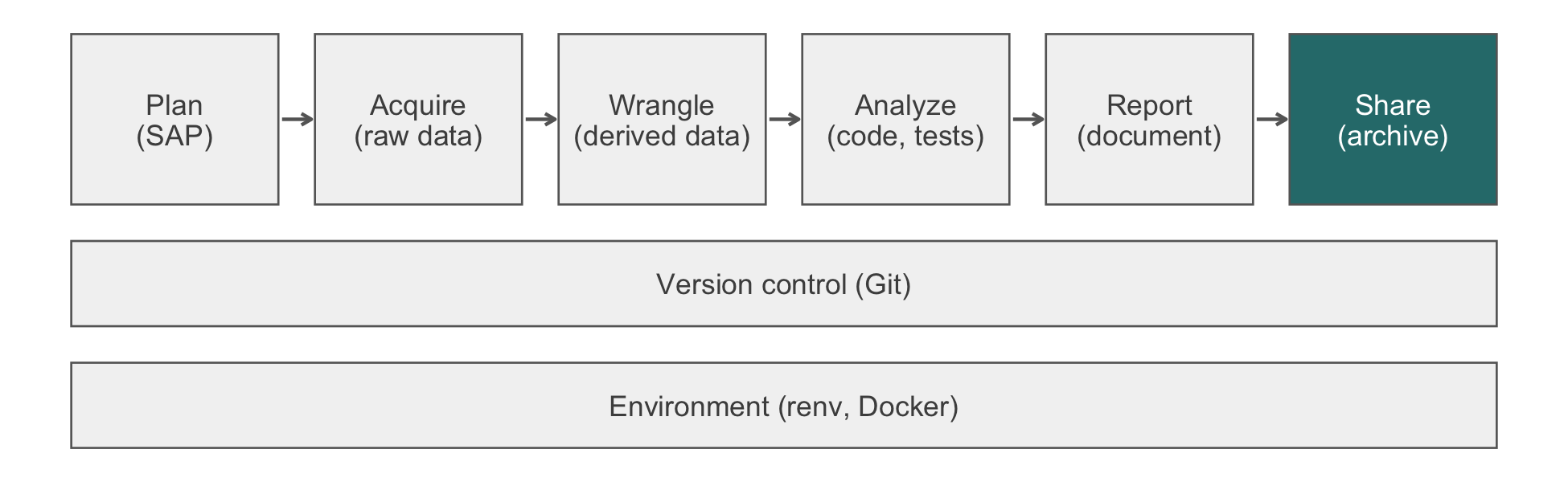
34 Federal Requirements and Deposition
The Data Management and Sharing Plan (DMSP) was written with the grant application, two years before the first dataset existed, and NIH program staff approved it as a term of the award. The plan written in the last hour before submission said ‘data will be deposited in a public repository at publication’, and nobody objected. At publication the analyst discovers what the sentence committed to. The participant-level data carry protected health information (PHI). The repository named accepts only de-identified data. Unconditional public release was never something the consent form allowed. Nothing failed when the plan was written. The failure appears only when the plan is carried out. Writing the plan so that it can be carried out is the subject of Section 26.17, beside the statistical analysis plan. This chapter is about the end of the project. It covers what the federal public-access policies require at publication, which repository each artifact goes to, and the check that runs before anything leaves the institution.
Sunlight is said to be the best of disinfectants.
Louis D. Brandeis, Other People’s Money and How the Bankers Use It (1914)
NoteIn this chapter
Reading time. About 15 minutes.
You’ll need. Section 26.17 for the HF-HOME DMSP and its deposit manifest, Chapter 22 for the de-identified release, and Chapter 9 for the lockfile. The code reads the running study’s files and uses:
You’ll be able to.
- Check a deposit, element by element, against the DMSP written at the start of the project.
- State which federal public-access requirements apply to a project, from a dated table you keep current.
- Choose a repository and an access mode for each artifact from its data type and its identifiers.
- Check a deposit manifest against an identifier list before anything leaves the institution.
- Choose a license for a compendium and write a
CITATION.cfffile that makes it citable.
Outline.
NoteSkip ahead?
If these answers come quickly, skip to the next chapter. The answers are in Section 34.8.
- What does the 2022 Office of Science and Technology Policy (OSTP) ‘Nelson memo’ require of federally funded research, and by when were agencies to implement it?
- Why are dbGaP and The Cancer Imaging Archive (TCIA) the wrong repositories for a trial’s general clinical data?
- Your code is public on GitHub. Is that a deposit, for the purposes of a DMSP?
34.1 What the policies require
The DMSP (Section 26.17) said what the project would share, where, and when. This section and the next concern the end of the project, when that plan is carried out.
The policy direction in the United States has been toward public access for publicly funded research. That has meant shorter embargoes, a wider scope (data and code, not only papers), and more auditing. The details change faster than any book can follow. They are therefore kept in one dated table, Table 34.1, and the prose keeps to what has been stable.
| Agency | Requirement | Effective | Source | Verified |
|---|---|---|---|---|
| OSTP, for all funding agencies | Peer-reviewed publications and their supporting data freely available at publication, without embargo; persistent identifiers | Memo issued 2022-08-25; agency policies in effect by 2025-12-31 | Office of Science and Technology Policy (2022) | 2026-10-091 |
| NIH | DMSP with every application that will generate scientific data; approved plan is a term of award | Applications for receipt dates on or after 2023-01-25 | NOT-OD-21-013 | 2026-10-09 |
| NIH | 2024 Public Access Policy: accepted manuscript submitted to PubMed Central on acceptance, public on the official publication date, no embargo | Manuscripts accepted on or after 2025-07-01 | NIH public access policy page | 2026-10-09 |
| NIH | Clinical trials registered and results reported on ClinicalTrials.gov | 2017 | NIH policy on dissemination of clinical trial information | |
| NSF | Data Management Plan of up to two pages with each proposal | NSF proposal guide | ||
| DOE, CDC, NASA | Agency public-access plans under the OSTP memo | Agency pages | ||
| FDA | CDISC-standard data for regulatory submissions (Chapter 28) | FDA study data standards |
1 Checked against secondary sources. Trade-press reports in 2026 that OSTP may reconsider the zero-embargo requirement were unconfirmed as of that date.
Three implications have held through every revision, and they are the ones that change what you do:
- Plan for the publication to be open from day one. No embargo affects journal selection, and the accepted manuscript, not only the typeset article, is what NIH requires.
- Plan for the data to be deposited and citable at publication. This affects the timeline: de-identification and repository review take weeks.
- Plan for the code to be deposited too. Funders increasingly expect it even where it is not explicitly required. A results claim without the code that produced it cannot be checked.
For a project funded by more than one agency, the most restrictive policy applies. The Food and Drug Administration (FDA) regime for industry trials is different in kind. It is a submission standard rather than an open-data policy, and it is more structured. It serves the same reproducibility role inside the regulatory process (Chapter 28).
WarningPitfall
A policy summary copied from a colleague’s plan is already out of date. Effective dates, notice numbers, and repository lists change. A plan that cites the superseded policy looks current to everyone who does not check. Cite the dated source, and re-verify each row of a table like Table 34.1 before you submit.
34.1.1 AI regulation touching data analysis
NoteAs of 2026-10-11
Regulation of AI use in research analysis and publication is changing on at least four fronts at once, each with its own dated requirement. Each entry below was checked against a primary source on the date given. Re-check before relying on any of them, because this area has changed roughly once a quarter since 2024.
FDA, AI credibility framework (industry submissions). In January 2025 the FDA issued draft guidance, Considerations for the Use of Artificial Intelligence to Support Regulatory Decision-Making for Drug and Biological Products (docket FDA-2024-D-4689). It proposes a seven-step, risk-based credibility assessment for any AI model used to generate or analyze data submitted in a regulatory filing (U.S. Food and Drug Administration, 2025). The comment period closed April 7, 2025. As of this writing the guidance has not been finalized. Trade coverage anticipates a final version in 2026. That is a forecast, not an FDA announcement, and it should be confirmed against FDA’s guidance-documents page before a submission relies on it. The guidance sits beside, and does not replace, the CDISC submission standard of Chapter 28. The credibility framework governs the model, and the CDISC standard governs the data format.
ICMJE, Section V on AI in publishing. The January 2026 update to the ICMJE recommendations added a standalone section on the use of AI in writing, analysis, and image generation. It requires disclosure of any AI assistance. It also holds that an AI tool cannot be listed as an author, because authorship requires accountability (International Committee of Medical Journal Editors, 2026). This book discloses its own use under the same rule (Section 12.3). Most biomedical journals that follow ICMJE inherit this requirement without a separate notice.
NIH, grant-application AI rules. Notice NOT-OD-25-132, Supporting Fairness and Originality in NIH Research Applications, issued July 17, 2025, applies to applications with due dates on or after September 25, 2025 (National Institutes of Health, 2025). It is a materiality standard rather than a blanket prohibition. An application substantially generated by AI, rather than lightly edited with AI assistance, is not treated as the applicant’s original work. A violation can trigger a research-integrity review. The notice is separate from the earlier NOT-OD-23-149 (June 2023). That earlier notice bars NIH peer reviewers themselves from using generative AI tools to analyze or critique an application, on confidentiality grounds. It was not re-verified for this edition and should be checked directly if it affects your role as a reviewer.
EU AI Act, compliance dates. Regulation (EU) 2024/1689 entered into force August 1, 2024 (European Parliament and Council of the European Union, 2024). Prohibited practices and AI-literacy duties became enforceable in February 2025, and obligations for general-purpose AI models began in August 2025. Most of the Act’s remaining provisions, including transparency duties, were scheduled to apply from August 2, 2026. However, a legislative package (sometimes called the ‘AI Omnibus’) was in negotiation during 2026 to delay parts of the high-risk-system timeline. At the time this was checked, secondary sources disagreed on whether that package had been formally adopted. Unverified as of this writing: confirm the current high-risk compliance date against the Official Journal of the European Union or EUR-Lex before stating it in a protocol or data-sharing plan, particularly for any analysis pipeline that would count as a high-risk AI system under Annex III (for example, one used in a clinical decision-support role).
None of these four is primarily about statistical methodology. All four affect a biostatistician anyway. Each treats an analysis pipeline, a disclosure statement, or a model’s credibility evidence as something a regulator or an editor can require. The practical implication for a protocol or a DMSP written today is twofold. Name, in one sentence, which of these four applies to the project. Then re-check the date before the manuscript or submission that depends on it. This is the same discipline Table 34.1 already applies to the older public-access requirements.
34.1.2 Exercises
- Two HF-HOME papers are funded by NIH. Paper A was accepted on 2025-06-20 and Paper B on 2025-07-10, and both are published in September 2025. Under the 2024 NIH Public Access Policy, which must be public in PubMed Central on its publication date?
NoteSolution
Paper B. The 2024 policy applies to manuscripts accepted on or after 2025-07-01, so the acceptance date, not the publication date, decides. Paper A falls under the earlier policy, which allowed an embargo of up to 12 months. A plan that relies on the publication date gets this wrong for every paper still in the pipeline on the changeover date.
NoteCheck
Question. Why does this chapter keep policy dates in one table rather than in the prose where each is discussed?
Answer. Because they are facts that go out of date. A date in a sentence is never re-checked, while a table with a ‘Verified’ column shows its own age. The prose keeps what has been stable (open at publication, data citable at publication, code deposited), which is what changes your plan. The table carries what changes from year to year.
34.2 Choosing a repository
The choice is less open than the list of candidates suggests. The data type and the access restriction between them determine it. Figure 34.2 shows the decision as it is made in practice.
flowchart TD
  A{"Participant-level<br/>or restricted data?"}
  A -->|"Yes"| X["De-identify first<br/><i>before any deposit</i>"]
  X --> B{"Domain repository<br/>for this data type?"}
  A -->|"No"| C{"Code, or data?"}
  B -->|"Yes"| D["dbGaP, TCIA, BioLINCC,<br/>Vivli, ICPSR<br/><i>controlled access, DUA</i>"]
  B -->|"No"| E["Institutional controlled<br/>access, plus a synthetic<br/>public surrogate"]
  C -->|"Code"| F["GitHub for work,<br/>Zenodo release for the DOI"]
  C -->|"Data"| G{"Domain repository<br/>for this data type?"}
  G -->|"Yes"| H["GEO, SRA, NeuroVault,<br/>ICPSR"]
  G -->|"No"| I["Zenodo, OSF, or Dryad"]
34.2.1 Matching the artifact to a repository
Each domain repository has a defined scope. Naming one outside its scope is the most common error in a draft plan. Table 34.2 pairs the artifacts a clinical project produces with a repository and an access mode. For every repository named, the default is de-identified data; deposit more only where the repository’s terms and your governing agreements explicitly allow it.
| Artifact | PHI as collected? | Appropriate repository | Access |
|---|---|---|---|
| Clinical-trial participant data | Yes; de-identify first | BioLINCC (NHLBI studies), Vivli, or an archive the funding institute designates | Controlled, DUA |
| Genotype paired with phenotype | Yes; de-identify first | dbGaP | Controlled |
| Cancer imaging | Yes; de-identify first (headers, burned-in text, faces) | The Cancer Imaging Archive (TCIA) | Open or controlled |
| Gene-expression or sequencing data | Usually not, for non-human studies | GEO, SRA | Open |
| Social-science and observational survey data | Often; de-identify first | ICPSR | Open or controlled |
| Code, data dictionary, summary tables | No | GitHub, archived to Zenodo | Open |
| Synthetic surrogate dataset | No | Zenodo or OSF | Open |
34.2.2 Hosting is not archiving
For deposition, a repository must provide a persistent identifier, a preservation commitment, open or controlled access as needed, and metadata fields for the discipline. Table 34.3 compares the three kinds a biostatistician uses.
| GitHub | Zenodo, OSF, Dryad | Domain repository | |
|---|---|---|---|
| Persistent identifier | No; URLs change | DOI per version | Accession number or DOI |
| Preservation commitment | None | Yes, stated by the repository | Yes |
| Fixed version | No; main moves |
Snapshot at deposit | Snapshot at deposit |
| Access control | Public or private only | Mostly open | Controlled access with DUA |
| Best for | Working code | Code releases, supplementary data | Primary participant-level, genomic, imaging data |
The practical pattern is therefore to work in GitHub and archive to Zenodo at each tagged release. Primary data go to the domain repository when one exists. Institutional repositories vary in quality. They are an acceptable backup but not always sufficient as the primary deposit.
Zenodo, OSF, and Dryad are not the only general-purpose repositories. Figshare and Harvard Dataverse serve the same role, and many universities run their own instance of one or the other. Software Heritage archives source code rather than data, and identifies each version with a permanent hash rather than a DOI. NIH accepts a generalist repository of this kind when no domain repository fits the data. It also lists the characteristics it expects of any repository: a persistent identifier, a commitment to long-term preservation, metadata that make the data findable, and clear terms of access and reuse (National Institutes of Health, 2020). Among repositories that meet that list, the choice matters less than the habit. Pick one, deposit each tagged release, and cite the DOI. Check your institution’s memberships first. The University of California, for example, is a Dryad member, so its researchers can usually deposit without the fee.
ImportantLLM prompt
Context. A two-arm clinical trial funded by NIH. Artifacts: de-identified participant-level CRF and outcome data, a codebook, analysis code, summary tables, and a synthetic surrogate dataset. The funding institute is named in the attachment. No data rows.
Constraints. For each artifact, propose a repository and an access mode, and quote the repository’s own statement of scope that admits this data type. Assume every participant-level artifact is de-identified and none is PHI.
Criteria. No repository is proposed outside its stated scope; participant-level data are under controlled access; a general-purpose repository is proposed only for code, tables, or synthetic data.
Failure mode. The model proposes dbGaP or TCIA for clinical data that fit neither (dbGaP is for studies pairing genotype with phenotype, TCIA for cancer imaging). Alternatively, it defaults to Zenodo for participant-level data because Zenodo is ‘general-purpose’. Check. Compare each proposal with Table 34.2, read the repository’s scope statement yourself, and see which repositories the leading trials in your field cite.
34.2.3 Exercises
- Name an appropriate repository and access mode for each:
- RNA-seq counts from a mouse experiment; (b) HF-HOME’s participant-level outcome data; (c) the analysis code and codebook for (b); (d) a synthetic dataset that lets a reviewer run the code for (b).
NoteSolution
- GEO for the counts (and SRA for raw reads), open access; no PHI is involved. (b) A clinical-trial repository under controlled access with a DUA, and only after de-identification. That means BioLINCC if NHLBI funds the trial and requests the data, otherwise Vivli or the institute’s designated archive. It is never dbGaP, which is for genotype-phenotype studies. (c) GitHub for working, archived to Zenodo at a tagged release for the DOI, open. (d) Zenodo or OSF, open, with the generator code if possible, so that the reviewer can see how the surrogate was made.
NoteCheck
Question. Your code is public on GitHub, with a README, a license, and a full commit history. The DMSP asks where the code will be preserved. Is a GitHub URL an adequate answer?
Answer. No. The reason is not that GitHub is unreliable. It is that GitHub makes no preservation commitment. A repository can be deleted, renamed, made private, or removed when an account lapses, and the citation then points at nothing. A repository also has no fixed identity. That is, main today is not main next year, so a bare URL does not say which version produced the results. A Zenodo release mints a DOI that resolves permanently and snapshots the repository at that commit. That is why the pattern pairs them. The same distinction applies to the SAP tag of Chapter 26. The tag marks the version, and an external, timestamped, immutable record is what makes it evidence.
34.3 Licensing and citation of code and data
A deposit at a persistent identifier (Table 34.3) answers where the compendium lives and whether it still will in ten years. It does not answer two separate questions a reader needs answered before reusing any of it. Under what terms may I use this, and how should I cite it? Two small files answer them. Both belong in the compendium’s root alongside renv.lock and the Dockerfile. Both are frequently missing from repositories that are otherwise exemplary.
34.3.1 Choosing a license
Under US and most other copyright regimes, no LICENSE file means no permission to reuse, by default. A public GitHub repository without one is browsable but not legally reusable, whatever the README implies. Three choices cover almost every compendium a biostatistician produces.
MIT, for code. A short, permissive license that allows reuse, modification, and redistribution, including commercially, with attribution. It is the default choice for the analysis scripts, the R package, and any software this book’s compendia contain. It is also what most CRAN packages use, and usethis::use_mit_license() writes it in one call.
CC-BY 4.0, for the paper, figures, and codebook. Creative Commons Attribution licenses prose, figures, and documentation for reuse with credit. Funders increasingly require this form for the manuscript and its supplementary material. It is also the natural license for a data dictionary or a README.
A data-specific license or none at all, for participant data. De-identified clinical data under controlled access are not typically released under an open license at all. The data use agreement (DUA) the repository requires (Table 34.2) governs reuse instead. Attaching CC-BY to participant-level data would claim an openness the consent form never granted. A synthetic surrogate dataset has no participant to protect. It can carry CC0 (public domain dedication) or CC-BY like any other open artifact.
Mixing licenses within one compendium is normal, and each should be stated explicitly. Use an MIT LICENSE at the root for the code, and a LICENSE-data or a statement in the data README for the controlled-access terms. A line in the main README then points to each.
34.3.2 CITATION.cff, so the compendium is citable
A CITATION.cff file (Citation File Format, a small YAML schema) tells both humans and tools how the project wants to be cited. The tools include GitHub’s own ‘Cite this repository’ button and reference managers. Without the file, a reader who wants to cite the compendium guesses a citation from the README, and two readers guess two different ones. A plausible file for the HF-HOME compendium:
cff-version: 1.2.0
message: "If you use this compendium, please cite it as below."
type: software
title: "HF-HOME: a two-arm randomized trial of home-health visits
  after heart-failure discharge"
authors:
  - family-names: "Statistician"
    given-names: "A."
    affiliation: "Department of Biostatistics"
version: 1.0.0
date-released: "2026-06-15"
repository-code: "https://github.com/example-org/hf-home"
license: MIT
identifiers:
  - type: doi
    value: 10.5281/zenodo.0000000
    description: "Archived release corresponding to this version"
Three fields are the ones most often left wrong. version and date-released should match the tagged release that the paper cites (Section 26.6), not the date the file was written. license should name the code license (MIT here), not the data’s controlled-access terms, since the file describes the repository it sits in. The DOI in the identifiers block is filled in after the Zenodo release exists. CITATION.cff is therefore written once and edited once more at release time. It is never left with a placeholder.
34.3.3 Linking a DOI to a release
GitHub hosts; it does not archive or mint identifiers (Table 34.3). Zenodo closes that gap through its GitHub integration. Once the integration is enabled for a repository, every new GitHub release (a tagged version, not a bare commit) triggers an automatic Zenodo deposit. The deposit mints a version-specific DOI and a concept DOI that always resolves to the latest version. The practical sequence for a paper’s compendium has four steps. Tag the release that produced the submitted results (git tag -a v1.0.0 -m "Submission version"). Publish it as a GitHub release. Let Zenodo mint the DOI. Then paste that DOI into both CITATION.cff and the paper’s data-and-code-availability statement. A reader who later finds the paper can resolve the DOI to the exact snapshot of code, renv.lock, and Dockerfile that produced the published numbers. This is the same guarantee Section 34.2 asks of a data deposit, applied to the code instead.
WarningPitfall
A CITATION.cff not updated at each release cites an outdated DOI. Suppose the Zenodo integration is left enabled and later commits are tagged as patch releases. If the version and identifiers fields of CITATION.cff are not updated, the file can point a citer at an outdated DOI. Meanwhile a reader finds the newest one on Zenodo. Update CITATION.cff as part of the release checklist, in the same commit that bumps the version tag.
34.3.4 Exercises
- A collaborator’s compendium has an MIT
LICENSEat the root and adata/folder containing de-identified participant-level CRF extracts with no separate statement about the data’s terms. What is wrong, and what should the compendium add?
NoteSolution
The MIT license covers the code. By its silence it implies nothing about the data. However, a reader skimming the repository could easily assume the permissive code license extends to the data folder too. The compendium should add an explicit statement, in the data folder’s README or a separate LICENSE-data file. The statement names the governing DUA or controlled-access terms and points to the repository where the data are actually held (Table 34.2). De-identified participant data belong under controlled access, not under an open code license, however permissive.
34.4 Rules of thumb
- Habit 5: pre-specify, then tag. The DMSP was the pre-specification of sharing; check the deposit against each of its elements, and build deposition into the pipeline.
-
Habit 4: pin the environment. The plan points to
renv.lockand a Dockerfile, and the deposit contains them. - Habit 1: the compendium is the unit. Deposit code, data, environment, and document together, each in the repository whose scope fits it, with de-identified data under controlled access.
34.5 Cumulative practice
-
Cumulative (uses Section 26.17 and Chapter 9). Rebuild
manifestfrom the Verification in Section 26.17, and extend it into a deposit manifest: add adestinationcolumn (controlled-access repository or Zenodo), add the codebook,renv.lock, and the Dockerfile as rows, and write astopifnot()that fails if anything bound for an open repository is participant-level or has identifier columns. - On your own work (no key). Pick a recent biomedical paper in your field. Check whether its data and code are reachable at a persistent identifier, whether the access mode suits the data, and whether the paper’s data-availability statement could be checked by a reader. Write one paragraph classifying its compliance.
NoteSolution to exercise 4
library(dplyr)

hf_dir <- file.path("..", "data", "raw_data", "hfhome")
identifiers <- c("mrn", "first_name", "last_name", "dob", "zip",
                 "phone", "discharge_date", "rand_date",
                 "visit_date", "event_date", "readmit_date",
                 "death_date")
files <- list.files(hf_dir, pattern = "\\.csv$")
manifest <- tibble(
  file = files,
  identifier_columns = vapply(files, \(f) {
    cols <- names(readr::read_csv(file.path(hf_dir, f), n_max = 0,
                                  show_col_types = FALSE))
    paste(intersect(cols, identifiers), collapse = ", ")
  }, character(1))
)

deposit <- manifest |>
  mutate(participant_level = TRUE,
         destination = "Controlled access, de-identified release") |>
  bind_rows(tibble(
    file = c("README.md (codebook)", "renv.lock", "Dockerfile"),
    identifier_columns = "",
    participant_level = FALSE,
    destination = "Zenodo (open)"
  ))

open_files <- deposit |> filter(destination == "Zenodo (open)")
stopifnot(!any(open_files$participant_level),
          all(open_files$identifier_columns == ""))
deposit |> select(file, participant_level, destination)
#> # A tibble: 11 × 3
#>    file                 participant_level destination
#>    <chr>                <lgl>             <chr>
#>  1 baseline.csv         TRUE              Controlled access, de-identified rele…
#>  2 crf_export.csv       TRUE              Controlled access, de-identified rele…
#>  3 demographics.csv     TRUE              Controlled access, de-identified rele…
#>  4 labs.csv             TRUE              Controlled access, de-identified rele…
#>  5 medications.csv      TRUE              Controlled access, de-identified rele…
#>  6 outcomes.csv         TRUE              Controlled access, de-identified rele…
#>  7 randomization.csv    TRUE              Controlled access, de-identified rele…
#>  8 visits.csv           TRUE              Controlled access, de-identified rele…
#>  9 README.md (codebook) FALSE             Zenodo (open)
#> 10 renv.lock            FALSE             Zenodo (open)
#> 11 Dockerfile           FALSE             Zenodo (open)
The two conditions encode two different rules, and the first is the one people forget. labs.csv and medications.csv carry no identifier column, so a check on identifier columns alone would let them go to Zenodo. They are still participant-level records, linked by patient_id to every other file. They belong under controlled access with the de-identified release. Even then the assertion is a structural check. It confirms that a listed identifier is absent, not that the data are safe to publish (Section 22.2).
34.6 Cheat sheet
| Task | Do | Guards against |
|---|---|---|
| Carry out the DMSP | Check the deposit against each element (Section 26.17) | A plan approved and never executed |
| Plan data sharing | De-identified data under controlled access; synthetic or summary data open | PHI or participant-level data in an open repository |
| Describe the environment | Point to renv.lock and a Dockerfile (Chapter 9) |
‘Standard R packages’ |
| Track policy | One dated table with a ‘Verified’ column | Superseded requirements cited as current |
| Archive code | GitHub release archived to Zenodo for a DOI | A citation to a URL that moves |
| Choose a repository | Match the data type to the repository’s stated scope | dbGaP or TCIA for general clinical data |
| Check before deposit | Manifest of files and identifier columns, with an assertion | An identifier leaving in a file nobody opened |
| License and cite the compendium | MIT for code, CC-BY for prose, a DUA for participant data; CITATION.cff with the release DOI |
A reader with no stated permission to reuse the work |
34.7 Further reading
- (Office of Science and Technology Policy, 2022), the 2022 OSTP ‘Nelson memo’.
- The NIH data management and sharing policy pages at
grants.nih.gov, the authoritative source for the DMSP and the 2024 Public Access Policy. - ICPSR’s Guide to Social Science Data Preparation and Archiving, portable to biostatistics for metadata practice.
- The Citation File Format specification at
citation-file-format.github.io, the schema behindCITATION.cff.
34.8 Prerequisites answers
- The Nelson memo (August 2022) directs federal agencies that fund research to make peer-reviewed publications, and the scientific data underlying them, freely available at publication. It removes the 12-month embargo that the 2013 Holdren memo allowed, and it calls for persistent identifiers. Agencies were to have their updated policies in effect by the end of 2025; Table 34.1 records each agency’s implementation and when it was last checked.
- Each has a narrow scope. dbGaP is for studies that pair genotype with phenotype, and TCIA for cancer imaging. General clinical-trial data fit neither. They belong in a clinical-trial repository such as BioLINCC or Vivli, de-identified and under controlled access (Table 34.2).
- No. GitHub hosts; it makes no preservation commitment, and a URL names no fixed version. Archive a tagged release to Zenodo (or a domain repository) for a DOI and a snapshot, and cite that.